
Me encontré toda la info de como fue concebido el Altezza de Touring y todos sus obstáculos para llegar a las pistas:
2001 saw the start of a new era in British Touring Cars (BTCC), it was out with the huge budgets of Super Touring and in with the new regulations aimed at vastly reducing costs in an attempt to attract new manufacturers and aid privately funded teams.
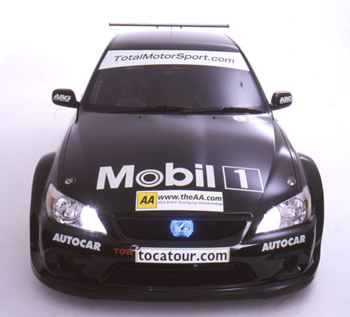
The new regulations controlled a large amount of the components used by the manufactures, items such as the tyres, gearbox, differential, ECU, brakes, hubs and even the rear wing and its position were stipulated by Toca. This would reduce the overall costs and create closer racing, in theory anyway. To give a greater visual effect for the TV and paying punters alike the cars carried a large, though non effective, rear wing, they had an increased front & rear track with a body kit to suit and a ride height of 80mm.
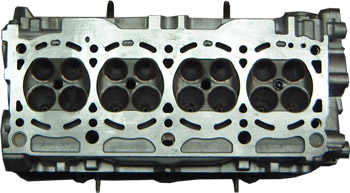
The engine regulations had been designed to give the cars approximately 270 bhp and tried to remove the grey areas that caused super touring costs to rise sharply. The final part of the equation was 17" racing wheels from OZ.
The first season of the new regulations boasted two manufacturer teams, Vauxhall and Peugeot, and two independent teams using cars from Alfa Romeo and Lexus. A move away from 4 doors was also encouraged with the introduction of coupes from Vauxhall & Peugeot and a 3 door hatch from Alfa.
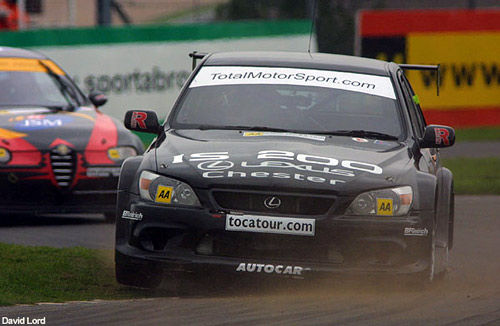
The Lexus though broke the conventions being used by the three opposing teams. The IS200 was a saloon car with rear wheel drive, (the others being front drive) and from the very first moment in the cars development, it looked simply sensational.
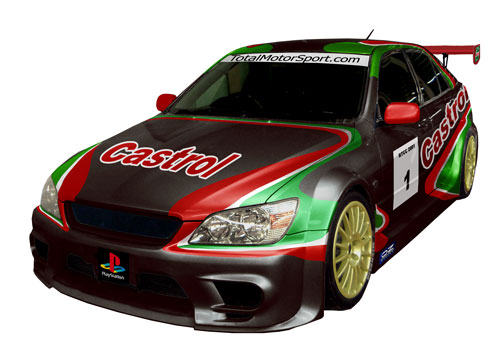
Early mock-up of car - boceto preliminar
ABG Motorsport (later to become TMS-R) was responsible for the conception and introduction of the Lexus Touring Car into the British Championship, having only had three months in which to design and build the cars. The team had to wait until late December 2000 for the homologation clearance from Toca, then the button could be pushed to start the development of the race car. In the mean time Vauxhall had already built the first of their Astra Coupe race-cars and would start testing in Spain in January 2001, some months before the Lexus would first turn a wheel.
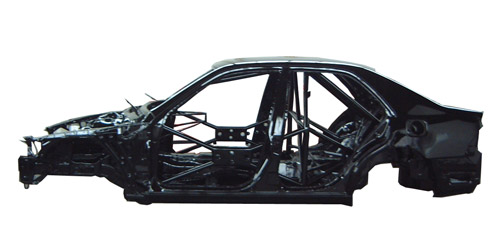
To compound the problem the team already had with the late start of the build, two road cars had to be completely stripped down to the bare metal before any further work could be done. The Lexus private team did not have the luxury of manufacturer support to aid them with body shells from the factory, as with the other teams, so every last bit of under seal, glue, sound proofing etc would have to be removed. This obviously takes hundreds of man hours alone but it had to done.
The new BTCC regulations allowed the teams to use an engine from the family of the manufacturer; in the case of the Lexus IS200 a four cylinder engine from the Japanese version (Toyota Altezza RS200) was used. The team considered this engine more suitable for the touring car application as this road car engine had been used by Toyota in various form of Motorsport already, from rally to Le Mans. In the standard road going form the engine develops 210bhp from the naturally aspirated 1998cc engine and includes components such as titanium valves as standard.
These engines though were not available in the UK through the usual channels, so the team had to buy engines from Japan that were available from their equivalent of a scrap yard. The team had little choice but to fly the engines into the country as weeks are lost in the buying process in Japan, time that they did not have.
Time was rapidly running out for the team at this stage and it was starting to increasingly look likely that the dead line for the first race would come and go. With only a couple of weeks to go before the first race the team still had not received some of the crucial components needed for the race car, including the uprights and suspension. These parts dually arrived a little more than a week before the first race at Brands Hatch in April 2001, and as soon as they were delivered the mechanics started working around the clock to put the first car together.
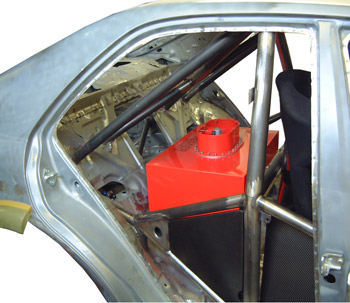
It was at this stage that the team hit an all time low. The suspension parts that arrived did not fit, at least not as they should! The only way forward was to try and make a way of for the components to fit, which meant all the detailed design work was out of the window. All parts on a race car are designed specifically to do a job in very precise position and environment, millimetres are like miles to designers and they essential if the car is to handle as it is designed too. As the front wish bones and track rods shared the same air space, the engineers had to lift the steering rack by some 17mm, akin to moving your front room into the neighbour’s back yard. Each component moved usually effects another part further down the line, so life for the Lexus was not looking too great.
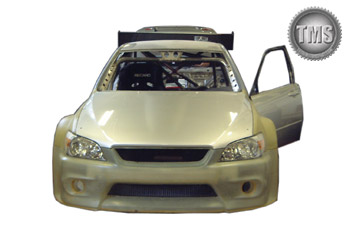
Coupled to this was the delivery of the first of the gearboxes. The transmission was 28mm shorter than in the design drawings, the same drawings that had been used to make the carbon fibre propshafts that had recently winged there way across from Austria. Yet again the Lexus team had been let down and another quick fix solution would have to be found. The team had also just received the news that flywheels had warped in the heat process of the manufacture. What else could go wrong?
It became all to apparent that the Lexus IS200 would not be racing in the seasons opener at Brands Hatch as a number of components still had not arrive and the car was yet to turn a wheel.
The week before the second race of the year at Thruxton, the Lexus team had received enough of the components to start conducting shake down tests at Pembrey in South Wales. These tests usually throw up a few problems, though not necessarily of the kind encountered with the Lexus at Pembrey.
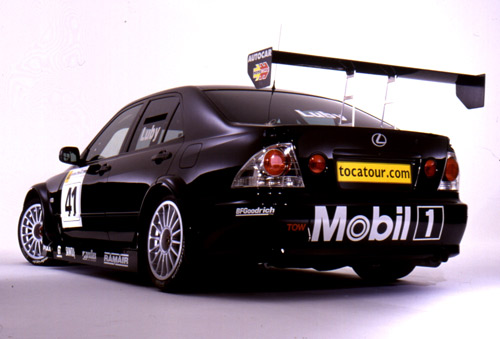
Kurt Luby had eagerly awaited this chance to try the car that would once again return him the touring car fold, his early days being spent behind the wheel of a BMW. He managed just one 'bedding in' lap before returning to the garages complaining of a variety of problems at the rear of the car. The first of these problems was related to the differential and the lack of oil that had caused it to cease, the second and slightly more worrying problem was the rather good impression the suspension made of half pound of bananas from the local Sainsbury's. Unbeknown to the team, the wish bones had bent when the car had been lowered from the air jacks for the exploratory lap of the circuit. The metal used to make the components had not been correctly prepared by the manufacturers and thus was as much use as a colour by numbers book is to Stevie Wonder.
This latest event lead to parts of the team disappearing to the four corners of the country over night to get new parts hastily made so they could continue the following day.
The second day was a slight improvement on the previous wind swept day, with Luby managing to get all of 13 laps in before the close of play. The car was then packed up and sent to Thruxton for the race in two days time.
The mechanics worked day and night to prepare the car for the first foray on track in anger, knowing all the development work would have to be carried out in front of the paying publics' eyes. The airbox, an item essential for the engines breathing, was due to be delivered for the Thruxton race along with a race prepared and correctly angled radiator, neither arrived following a torrent of excuses, meaning the Lexus would be down on power for the weekend.
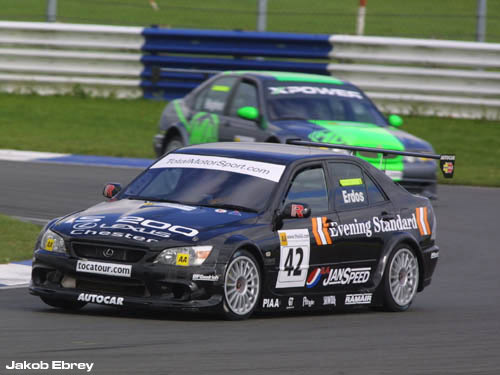
Thruxton though proved to be the turning point for the Lexus, amazingly managing to finish fifth in the hour long feature race much to the surprise of the public and the team. From that point on the car became a huge favourite with the BTCC fans, constantly out selling the rest of the opposition in the merchandise stakes.
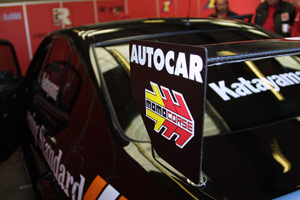
The car though would have to remain compromised for the rest of the season as under the regulations only a limited number of changes could be made to a car once the season had started and testing was very much restricted to help make the new regulations more affordable.
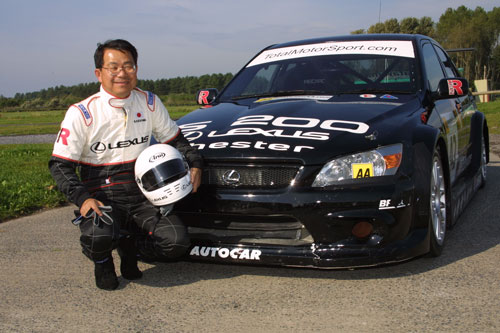
Mr Katayama- Toyota Chief Engineer & designer of Lexus IS200/300
So the Lexus IS200 struggled on through out the season, often being the only the car to offer any resistance to the dominant Vauxhall Astra's, incredible considering the challenges the team and the car had to endure. For the first half of the season the Lexus had used the differential settings designed for the front drive cars as the supplier could not manufacturer the correct components in time. Unfortunately for Kurt Luby the correct rear differential and drive shafts arrived too late in the day for him to try, though they were fitted in time for the introduction of Thomas Erdos at Knockhill.
Thomas though still had to endure the lack of heat generated by the tyres due to a minimal amount of camber adjustment in the original design, a race-car that was still some 28kg over weight and a passive rear steering sub frame at the back of the car that gave incredibly inconsistent handling. When you add to this the fact that the closest the car came to a wind tunnel was a windy day stuck in an open garage at Pembrey it soon becomes apparent just how much potential the Lexus IS200 Touring Car really has!
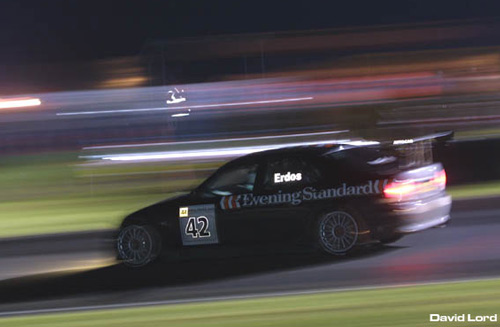
Vehicle Specification
Lexus IS200 2001
Engine
Capacity: 1998cc
Cylinders: 4
Power: 286bhp @ 8500 rpm
Valves: 16 (Titanium)
Transmission: Xtrac 6 Speed Sequential
Differential: Xtrac Plate Differential
Prop-shaft: Carbon Fibre
Weight: 1128 KG (with driver)
fuente:
http://www.totalmotorsport.com/Features ... .asp?ID=18